Making a Difference for the Monarchs at Moraine Farm

Science in Nature Update
By Coleen Ryan, Science in Nature Coordinator

During September, the students have been learning about Monarch caterpillars and their incredible transformation. Monarch butterflies are indeed beautiful to behold, and they are also important pollinators in the ecosystem. They eat plenty of weedy plants and provide a food source for other animals. Their presence or absence can tell us a lot about the local environment.

This September we have been fortunate to encounter many Monarch caterpillars, more than the two previous years combined! This is surprising as the current statistics on Monarch populations show they have been in steady decline. While this is true as a global issue, we help the children focus on what positive influence we can have in our local Moraine Farm environment. Sharing about negative global issues with children, especially those younger than fourth grade can be too abstract and overwhelming for them. It can have the opposite effect than is intended, leading them to be less caring about the environment and more fearful and disconnected instead. To be involved, and have positive influence on these butterflies’ survival allows the students to feel connected to, and proud of their contributions to these beloved local favorites. It also allows the students and community pause to witness a very special transformation that would otherwise go unseen in the busyness of our lives.

Check out a molting Monarch caterpillar! They do this many times, shedding their skin as they grow.

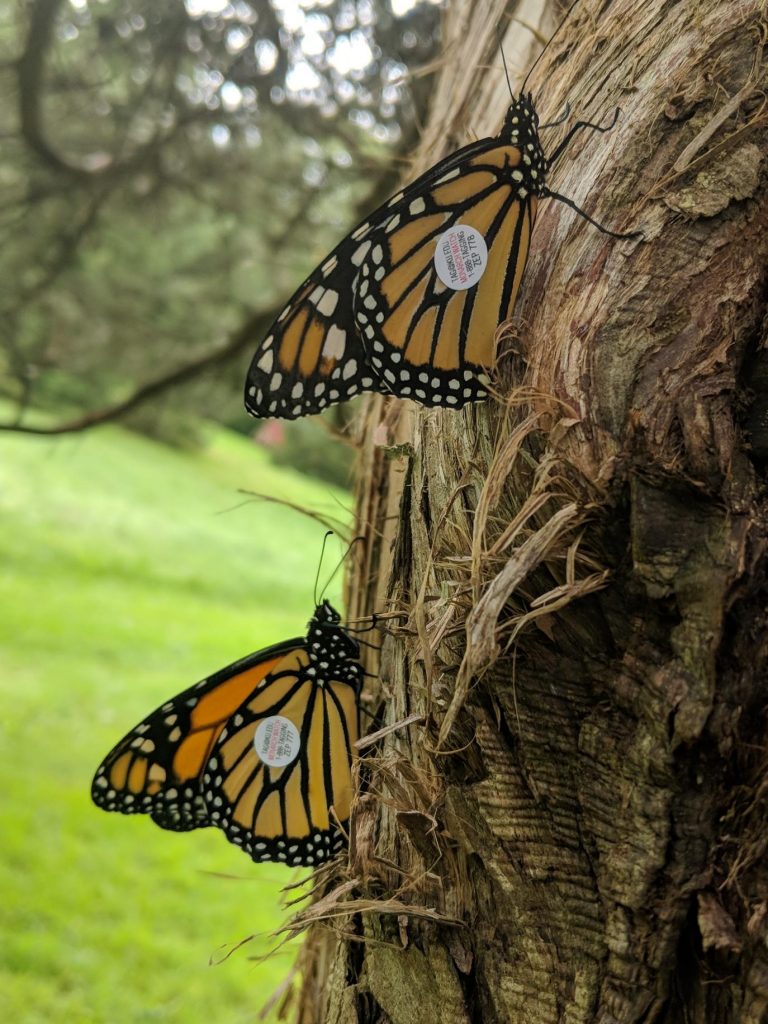
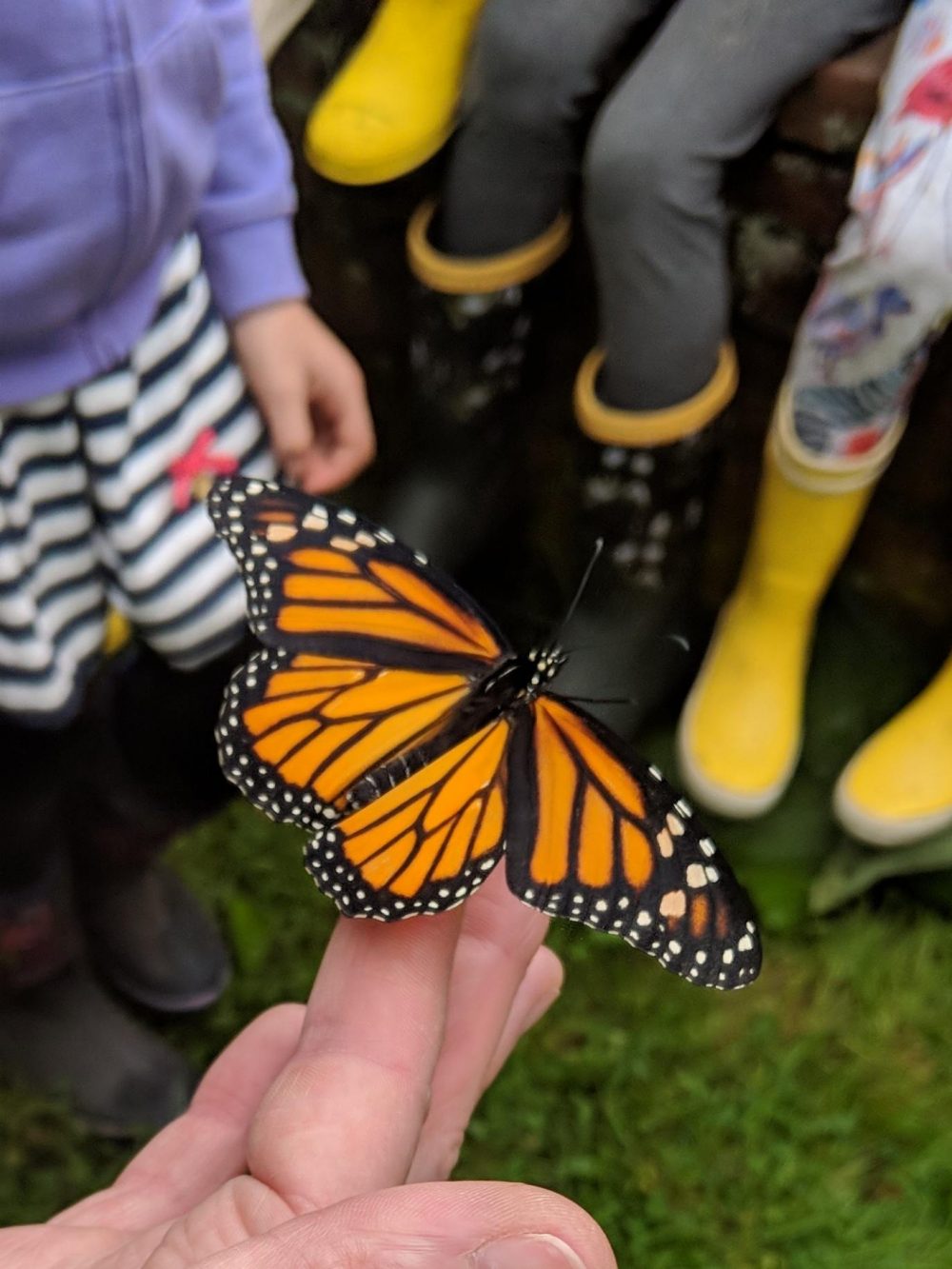
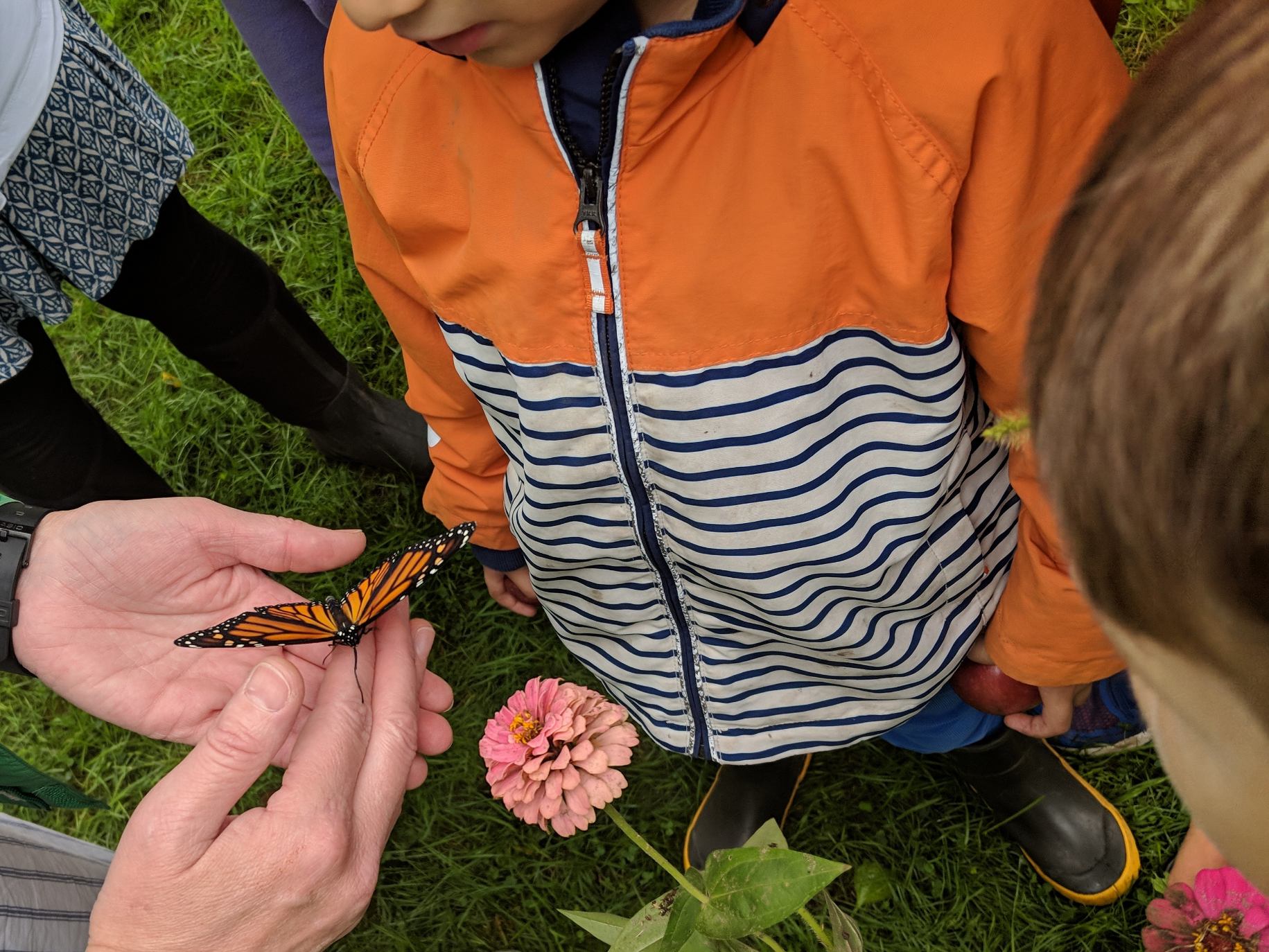
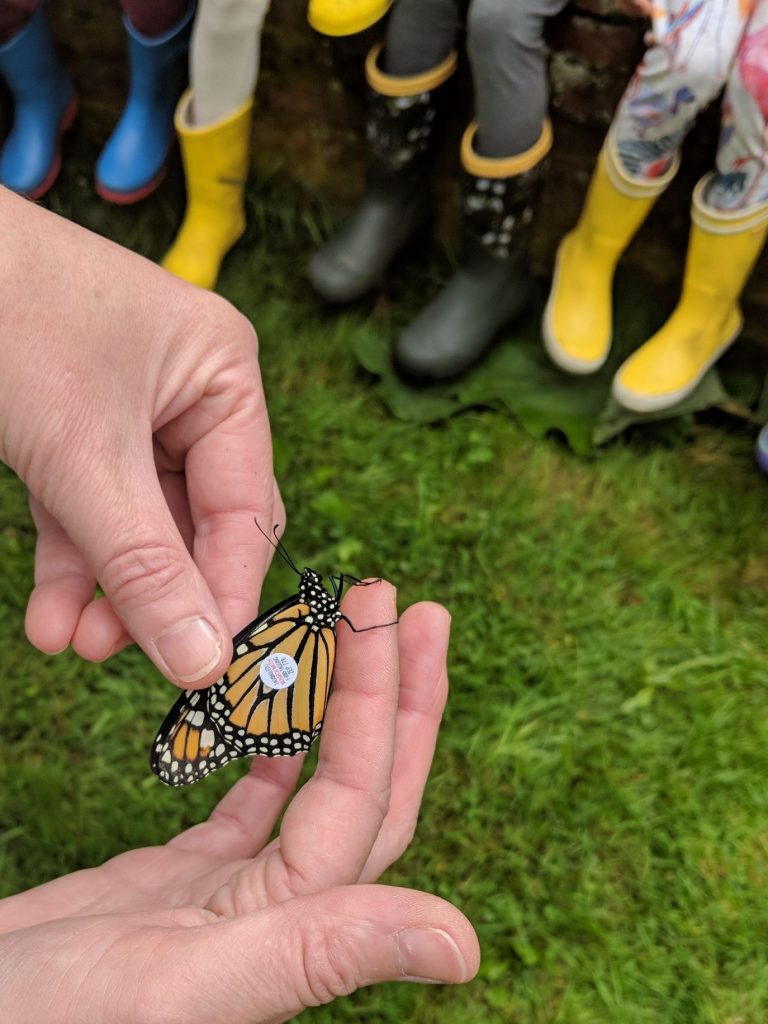
For the past three weeks the students have been gently collecting the caterpillars, bringing them inside where they continue to eat and grow at an impressive rate. At this time we have over 50 chrysalises and they are now starting to emerge as butterflies. During the summer the butterflies in our area emerge and reproduce. The butterflies that are now coming out will not spend any of their built-up energy on reproduction; instead they will head south, through Florida and into the mountains of Mexico. There they will spend the winter. The Monarch’s migration is thought to be brought on by seasonal changes such as the shorter length of days and cooler temperatures.

For the first time this fall our school is participating in a Monarch tagging effort organized by Monarchwatch.org. As the Monarchs emerge each class will have an opportunity to identify what gender they are and affix a small sticker to their wing. That information will then be recorded online. The “Monarch Watch tagging program is a large-scale citizen science project that was initiated in 1992 to help understand the dynamics of the monarch’s spectacular fall migration through mark and recapture.” “Tagging helps answer questions about the origins of monarchs that reach Mexico, the timing and pace of the migration, mortality during the migration, and changes in geographic distribution”
Waldorf School at Moraine Farm Presents: Windows Into the World of Waldorf Open House on September 29

On Saturday, September 29, Waldorf School at Moraine Farm will host an Open House starting at 10am where visitors will experience the value of Waldorf education for themselves.

Parents have numerous options here on the North Shore which is why it’s so important for families to make the most informed decision they can about their children’s educations and futures. How well a child performs and learns in school now has lasting effects on their high school, college and life experiences as well.

The upcoming event, Windows Into the World of Waldorf, is an excellent way for families to experience what a Waldorf education offers, how a child learns in a Waldorf environment, and how Waldorf School at Moraine Farm differentiates from all other public and private schools in the area.

Visitors may choose from a series of 30-minute classes in Math, Science, History, Language Arts, Music, Cyber Civics, Nursery and Kindergarten classes, specific to a range of grade levels. While in class, experience what it’s like to be taught in the Waldorf method and see how engaging it is to be a student at the school.

Experience how Waldorf’s time-tested approach to education promotes a learning environment that allows for self-discovery, creative problem solving and high achievement.

For information or to register click here.

Science Learned in Nature Creates Meaningful Experiences

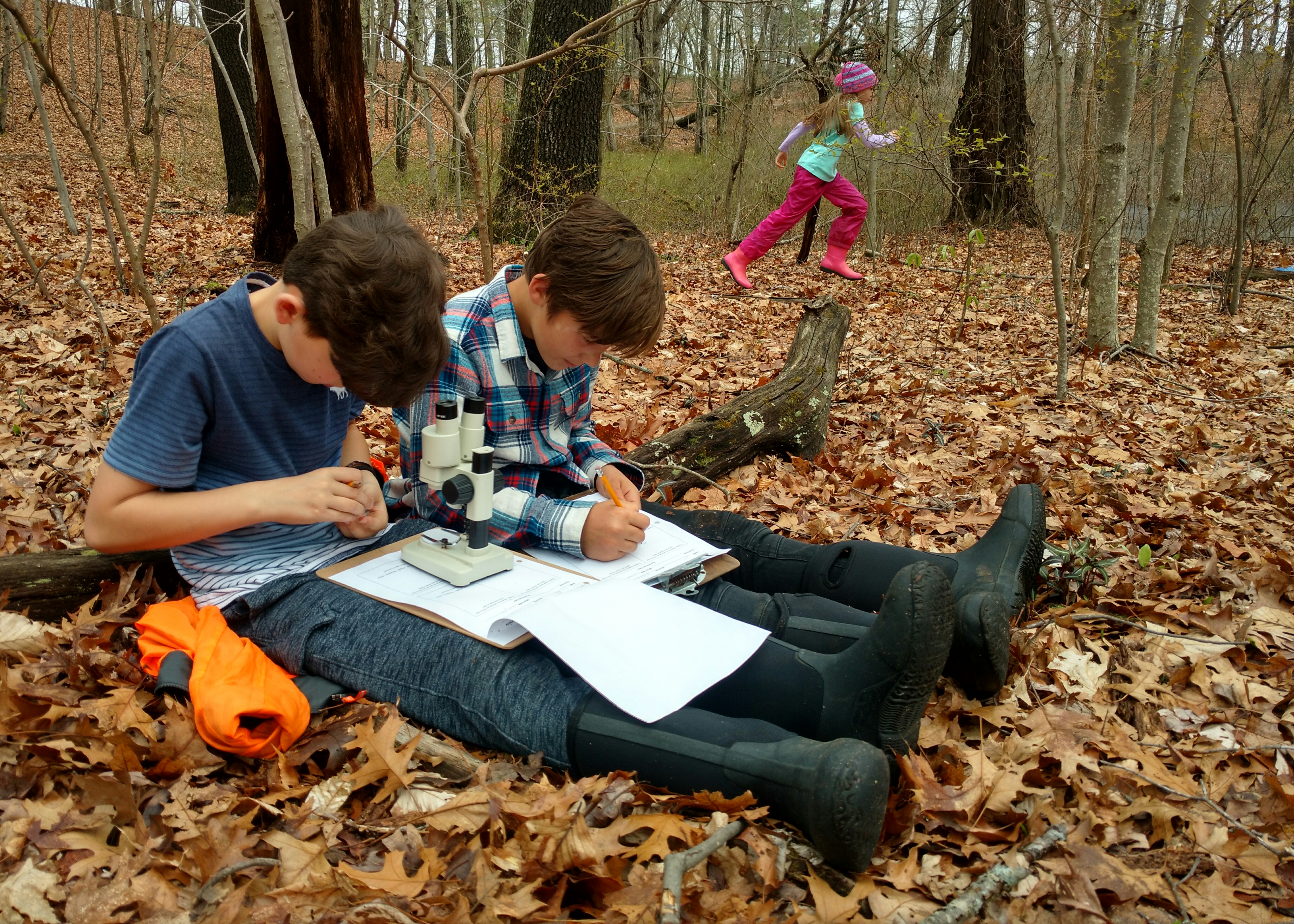
This year each grade has two classes per week devoted to Science in Nature. During these classes, we explore the rich, natural setting of Moraine Farm to enhance and supplement the existing science curriculum. Hands-on, experiential lessons cultivate scientific observational skills as well as a connection to the earth to help students become discerning stewards of the land throughout their lives.

This slideshow requires JavaScript.

Craig Holdrege, PhD—biologist, educator, and director of The Nature Institute, stated at a lecture given at Waldorf School at Moraine farm in 2015, that to become sustainable, to allow life to flourish and not merely exist, we need to be open and willing to change with new ideas. This is not necessarily about just preparing students for today’s society or maintaining the status quo; rather, our goal is to help students be part of a world in which we thrive and move forward towards sustainability. For this, we must learn to think and imagine the future with flexibility, wisdom, warmth, and deep understanding for the earth and all of its inhabitants.

How do we nurture and educate children to have the above capacities? This is one of the challenges of education today, and at Waldorf School at Moraine Farm, we aim to cultivate these capacities through all of our programs, including the Science in Nature program.

As teachers, we ask ourselves what kind of experiences are meaningful for students and how do we encourage them?

The experiences that matter are the “real” ones that have drama and a commanding presence. A commanding presence is an elusive quality, but is certainly identifiable. Many experiences in nature have that “commanding presence”. While out with the first and second grade on the shores of Lake Wenham in February, we caught a glimpse of a bald eagle. As it soared overhead, our fingers and eyes were looking upwards trying to track the eagle’s movements. Everyone stopped what they were doing and strained to look in the direction where it had disappeared towards the meadow. Then as we were all silently and hopefully waiting, it re-emerged from that same direction with tufts of dry grass and sticks tucked in its talons. It flew overhead and landed in the tall pine trees on the other side of the lake. While this was just a passing moment, it led us to more questions, such as: “What is the eagle doing?”; “Is there a nest?”; “Does it have a mate nearby?” Some of the children recalled seeing an eagle, perhaps even the same one, the year before in kindergarten. These are the types of unplanned moments that together lead towards a deeper interest, connection, and awareness of the natural world around us

Aldo Leopold said (quoted in the book Aldo Leopold’s Odyssey, by Julianne Lutz Warren) “There is drama in every bush if you’re willing to see it.” He believed that weeds on a city block could share the same lessons as the redwood forest. He imagined a future where we would know the drama of nature and show no indifference to the weeds. He thought we would have no need for conservation. While he was seemingly optimistic, his words still hold true: there is a presence that can be found in nature which we can experience and which moves us toward longer-term sustainability.

We are fortunate to have our beautiful school campus and its surrounding 275 acres of Moraine Farm just outside our doors. As we concluded the maple sugaring season and moved into spring, the children helped to prepare the garden for a new season of growth. We turned over the soil, improving it, and planted new seeds. Through this practical work we continue to come to know the land better, come to envision ourselves as long-term stewards and students of the earth, and enjoy the unplanned moments that present themselves along the way.

By Coleen Ryan, Science in Nature Coordinator

Waldorf Education: The Importance of Rhythm in Early Childhood

As Waldorf early childhood teachers, one of our fundamental tasks is to offer the children a breathing-like rhythm to our day together – breathing in, as with listening to a story or resting, and breathing out, as in running, playing and roughhousing. In and out, in and out, throughout the day.

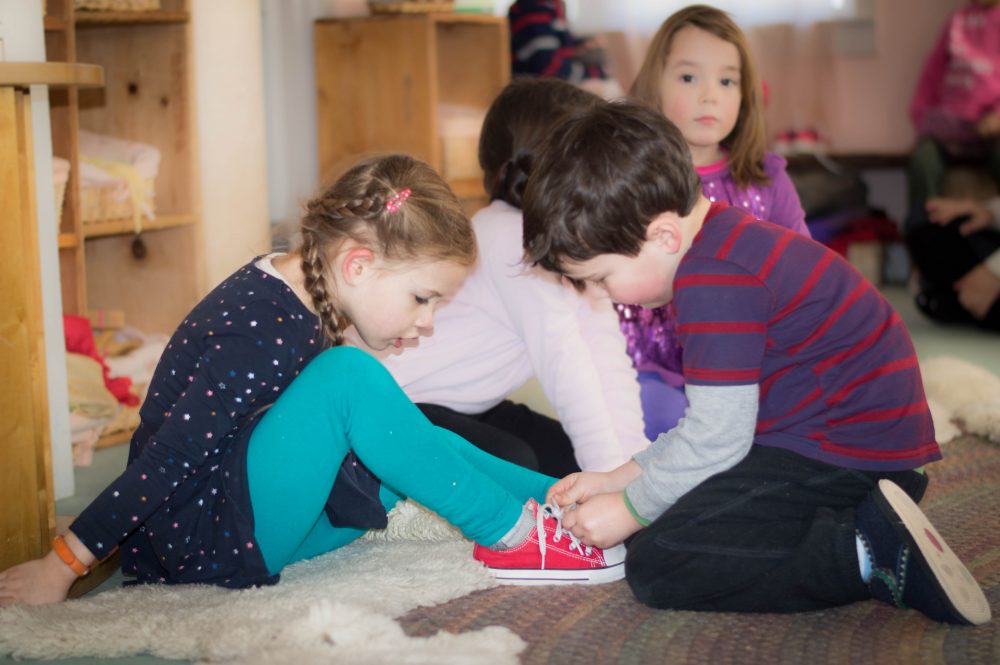
The early childhood curriculum is filled with bread baking, uninterrupted play, music and puppet stories. All are there for important reasons but it is the rhythm itself that enables the children to participate successfully. At its most basic, the rhythm in our nursery class begins with free play, an open time of breathing out when the children can play and find other meaningful ways (like helping teachers in food preparation) to enter into the day at school. After free play, we transition towards the breathing in of circle time. Because circle requires each child to find the attention needed to engage in our group activity, we transition towards it gradually — first we gather our focus to tidy up the room, then we quiet down together to have a short “sip of water” at the table. We are then each as ready as he or she can be for the deep in breath of circle time.

And on the day goes, back and forth in this way, with some breaths shorter and some longer as needed. We are like a river, each of the children finding their way in the water as it bends naturally back and forth through anticipated twists and turns.

Each child meets the rhythm in their own way. Recently, an older child has been coming into the nursery to tumble on the floor, smile at his teachers, and then build a block tower, while a younger child has been coming in to sit down by her teacher and rub coconut oil on the kale leaves. Later, both will gather themselves together to join in circle time, one participating on the floor in front of me, stopping himself from getting too silly, the other standing off to my side, imitating the movements with her hands.

“Life, with its rules, its obligations, and its freedoms, is like a sonnet,” Madeleine L’Engle says in A Wrinkle in Time. “You’re given the form, but you have to write the sonnet yourself.”

Our form is not as simple or static as a sonnet, of course. It is organic and changing. It will grow as the children grow. In kindergarten, circle time and stories may be longer, while free play and other breathing out time may not be longer but instead will be more active and robust. The children’s ability to settle into painting and other artistic activities will expand too. Later, and in this same way, the grade school students will have developed some of the faculties needed to focus on more purely academic work. And later still, the sixth, seventh and eighth graders’ ability to work longer and harder at challenging topics will be supported and enhanced by a strong breathing rhythm. They won’t call it play time, but the eighth graders will still be going outside for some rejuvenation at recess, to breathe out after a long morning of breathing in.

As Waldorf early childhood educator Susan Weber says in her essay, Some Thoughts on Rhythm, “This work-play-rest rhythm is a healthy habit for a whole lifetime.”

By Mari Yamaguchi
Nursery Teacher

A Window into the Eighth Grade Language Arts Curriculum

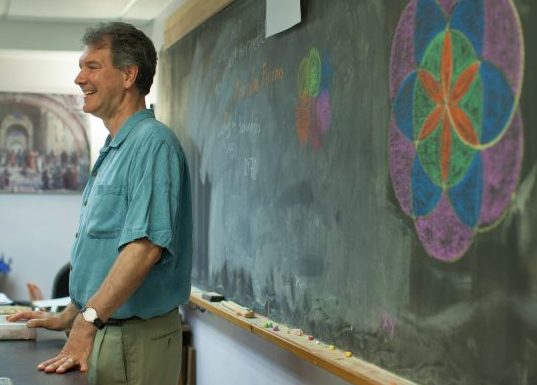
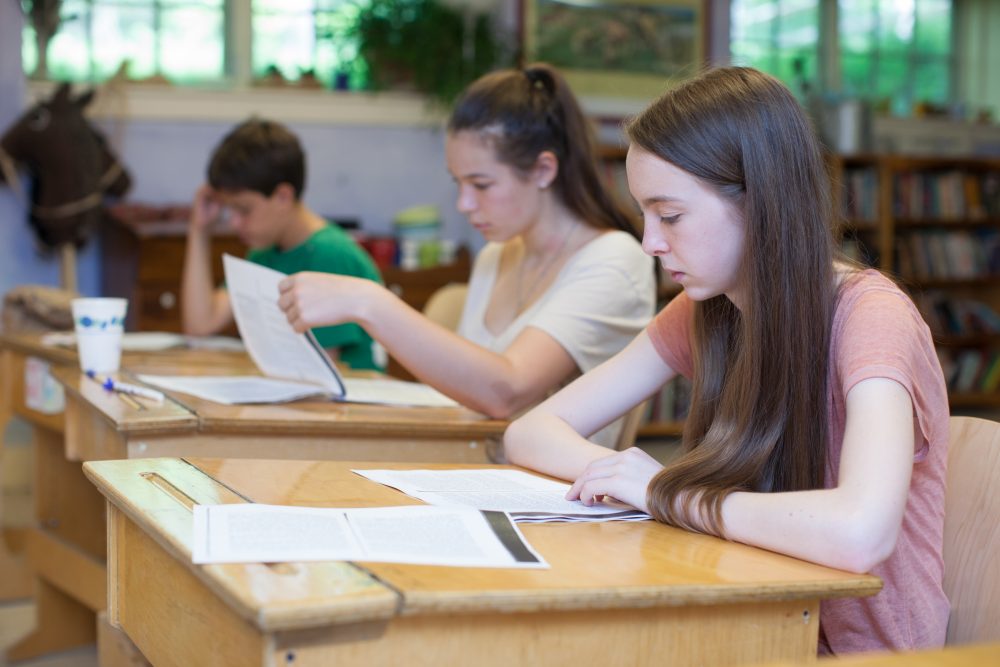
A language arts curriculum generally focuses on words—reading words, writing words, speaking words and listening to words. Words are powerful, mystical, and musical. They evoke strong feelings and can paint beautiful pictures. Rudolf Steiner says that “our task is to educate the human being in such a way that he or she can bring to expression in the right way that which is living in the whole human being, and on the other side that which puts him/her into the world in the right way.” At Waldorf School at Moraine Farm, the eighth grade language arts class focuses on teaching language to engage the whole student and to prepare her for the next part of her journey, high school.

When reading or listening to stories, students begin making meaning through the sounds they hear and the pictures they imagine. In language arts, the eighth graders read and hear a wide and varied selection of traditional and contemporary literature. The literature includes short stories by authors such as Amy Tan, Gabriel Garcia Marquez, and Sandra Cisneros, poems by William Blake, Nikki Giovanni, Langston Hughes, and William Shakespeare, to name a few, and a longer work of prose, usually a novel. This year students read To Kill A Mockingbird by Harper Lee. Through class discussion students find deeper meaning in the literature by connecting the stories to their own lives and the world they live in. A developing vocabulary of literary terms such as plot, point of view, characterization, and theme helps them to see the many different parts of stories that make up the whole, multi-faceted picture. At times it’s almost a bit like looking through a kaleidoscope. Often, during this time of beginning analysis, students move from making observations about a piece of literature—That tiger is scary in the poem!—to discovering how the author creates that effect—The fire imagery and trochaic meter make the tiger seem scary.

In the middle school years, as students’ feelings and thoughts grow more complex, it is important for students to have the writing skills necessary to engage in the greater world they live in, and to express themselves with clarity, confidence and creativity. Equally important is that students experience writing as a process and not as a finished product. The eighth graders practice the writing process by brainstorming, then moving to drafting, and finally to editing and revising. They write their own short stories and poems while learning about the connotation and denotation of words, the difference between concrete, abstract and precise language, as well as the difference between details that show and details that tell. Students write paragraphs with topic sentences, supporting evidence and concluding statements, and they learn how to cite evidence from a work of literature by integrating a quotation into their writing. They also review the template of the five-paragraph essay—introduction, body paragraphs and conclusion.

Steiner recommends “word teaching” or teaching the parts of speech to children under twelve years and teaching syntax, the arrangement of words and phrases, to children older than twelve years.1 The eighth graders review the parts of speech before moving on to noun functions, clauses, phrases and sentence types. A confidence often begins to emerge and grow as middle school students, beginning to understand and play with syntax, see the flexibility and fluidity of language.

A culminating writing project in the eighth grade year in language arts is the independent research paper. Students choose their own American history topic to research and write about. They generate an essential question to guide their research, and, after doing research, they answer that essential question in the form of a thesis statement. Some of this year’s essential questions were What happened to the lost colony of Roanoke? What made the Underground Railroad so strong for so many years? What factors led to Frederick Law Olmsted’s unique style of landscape design? Could the British Petroleum oil spill disaster have been prevented? During the research stage students learn how to find sources, both online and off, and how to differentiate good sources from bad sources. The digital literacy skills they learn in CyberCivics, an integral part of the middle school curriculum at Waldorf School at Moraine Farm, help them become better and more efficient researchers online. During this unit, eighth graders become burgeoning experts on something they are deeply interested in, and they derive great satisfaction from that feeling of expertise. They experience the rhythm of research—questioning, answering, and questioning some more—and that experience nurtures curiosity and fosters life-long learning.

Writing graduation speeches is the culminating unit in eighth grade language arts. This is a wonderful time for students to reflect on their journeys as Waldorf students, both individually and collectively, before moving on to high school. After many years at Waldorf at Moraine Farm, students graduate having experienced a rich curriculum immersed in legends, fairy tales, stories from the Hebrew scriptures, Greek myths, Norse mythology, Shakespeare, and so much more. The music and pictures of the words Waldorf students have been hearing, reading or speaking for many years have built a strong foundation in all aspects of the language arts. The eighth grade language arts curriculum finishes that strong foundation. Students are ready and eager to continue exploring the world of language and literature with confidence and wonderment in high school.

1 Harrer, Dorothy. An English Manual for the Elementary School. Association of Waldorf Schools, 2004.

Written by Amanda Wiederhold, Middle School Language Arts Teacher